Competing quotes, the license lookup, and the leverage window
Installer choice in Browns is mostly sequence: collect competing quotes first, verify the license second, negotiate clauses third, sign last. Reverse the order and every later step costs more. The verification list is below.
Business alarm systems quoted around Browns run $500-$2,000 installed for basic setups in 2026 industry guides - typical installs $1,500-$3,000 - and the number to compare is the install price plus the full monitoring-contract total.
Most monitoring contracts offered in Browns carry an automatic-renewal clause: miss the written-notice window, commonly 30-60 days before term end, and many contracts renew themselves for another 3-5 years.
Browns plus 10 surrounding communities within 40 km hold about 43,519 people - enough market density for multiple installers, which is exactly the competition a quote request should exploit.
Security vendors are easy to compare and rarely compared - most buyers collect one quote and negotiate against nothing. The marketplace model exists precisely to fix that: one form, several competing installers, leverage restored.
What you can verify beats what a rep promises: the license (your state's lookup is linked below), the contract term, the renewal window in writing, and whether the quote survives a competing bid.

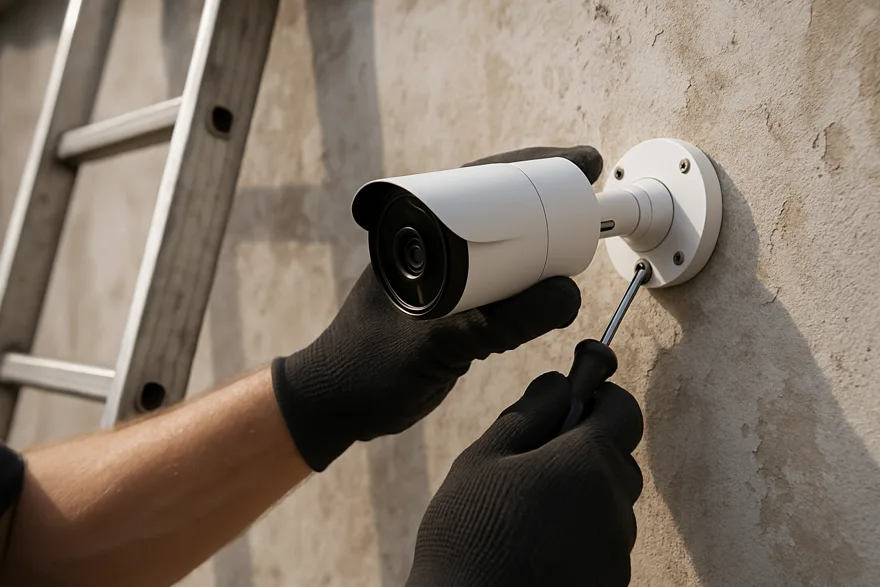

The 2026 numbers
| Security category | 2026 published range | The number that actually matters |
|---|---|---|
| Business alarm system (installed) | $500-$2,000 basic; $1,500-$3,000 typical | The install price next to the full monitoring-contract total - not alone |
| Alarm monitoring (small business) | $50-$100/month | 36-month terms are standard; the renewal clause decides the real end date |
| Monitoring contract term | 36 months typical (12-60 range) | Miss the 30-60 day notice window and many contracts renew 3-5 more years |
| Commercial cameras | $100-$1,500 each ($150-$600 typical installed) | Recording is the second budget: NVR $400+ once, or cloud $10-$30/camera/month forever |
| Access control (per door) | $900-$4,000 installed | The 4x spread is bundling, not technology - demand a scope list per door |
| False alarm fines (municipal) | $50-$300 per incident, escalating | 94-98% of alarm calls are false (DOJ-funded guide) - fines exist because of it |
| Full integrated system (small-mid business) | $8,000-$30,000 | Real if you need alarm + doors + cameras together - needs first, then quotes |
Put competing security quotes out to competing bid before talking price
Two free marketplace paths: one form brings back multiple vetted installers who know they are competing for the job. Competing quotes are the only pricing discipline this industry consistently respects.
External links go to the marketplaces' own sites and forms. This site may earn a referral fee at no cost to you - it never changes the data above, and no individual installer pays to appear in our research.
Walk away when you see
- A quote that leads with 'free installation' and hides the contract term total
- Auto-renewal for multiple years behind a notice window measured in days
- A 3G or landline-only communicator - both are on sunset paths and will strand the system
- Pressure to sign before a competing quote arrives - leverage dies at signature
- No license number on the proposal in a state that requires one (lookup linked below)
Verify before any signature
- Get at least two competing quotes on identical scope before negotiating with anyone
- Check the installer's license in your state's official lookup - linked on this page where your state has one
- Read the renewal and escalator clauses aloud before signing - then calendar the notice window
- Ask for the monitoring center's UL listing and the response protocol in writing
- Confirm your city's alarm permit is filed before activation - unpermitted fines commonly reach $500
Who licenses security work in Illinois
| Question | Illinois answer |
|---|---|
| State license for alarm/security installers | Yes - Illinois Department of Financial and Professional Regulation (IDFPR) - Licensed Private Alarm Contractor / Agency license required statewide to install, service, or monitor burglar and fire alarm systems, under the Private Detective, Private Alarm. |
| State-level alarm rules | State law governs contractor licensure (225 ILCS 447) but not false-alarm response; false-alarm fines/ordinances are municipal (e.g., City of Chicago requires separate registration of IDFPR-licensed. |
Illinois bundles alarm contractor licensure into the same Act and board (IDFPR) that licenses private detectives, security guards, and locksmiths; applicants must be 21+, have 3 of the last 5 years of qualifying experience (1,500 hrs/yr), and the licensure exam is offered only twice a year (March and September), creating a real bottleneck.
This page is independent research, not legal, insurance or purchasing advice. Licensing rules, alarm ordinances and fine schedules are set by states and cities and change - verify current requirements with your state licensing board and your city's alarm program before acting.
What this means in Browns
What costs Browns businesses the most is rarely the hardware - it is paying for it longer than they meant to, plus the false-alarm fines a rushed installation earns on the city's escalating schedule.
This page is independent research, not legal, insurance or purchasing advice. Licensing rules, alarm ordinances and fine schedules are set by states and cities and change - verify current requirements with your state licensing board and your city's alarm program before acting.
Common questions
Do I need an alarm permit for my business?
In most mid-size and larger US cities, yes - a permit before the monitored system is activated, often tied to a false-alarm reduction program. Operating without one commonly draws fines up to $500, and some cities bill per day. The schedules are municipal, so the specific numbers live in your city's code - the pattern (register first, free responses, then escalating fines) is close to universal.
Should I choose cloud or local storage for cameras?
Local NVR storage costs once - roughly $300-$700 in hardware plus a hard-drive swap every few years - and keeps footage on your premises. Cloud storage bills every camera every month ($10-$30 typical) and survives theft or fire of the recorder. Neither is wrong; the honest math is your camera count times the monthly cloud fee, compared over five years against the NVR you would buy.
Do security installers need a license?
It depends entirely on the state - and the differences are large. Some states run dedicated alarm-contractor licenses with exams and background checks, some fold alarm work into electrical licensing, and a handful have no state license at all, leaving regulation to cities. This site's page for your state names the licensing body and links the official lookup where one exists - checking a license takes about two minutes and is free.
How much is commercial alarm monitoring per month?
Small businesses with basic systems commonly pay about $50-$100 a month; large or complex facilities run several hundred. One hard rule hides in the fine print: commercial fire alarm monitoring must go through a UL-listed central station under NFPA 72 and local fire code - self-monitoring is not a legal option there, whatever a DIY brochure implies.
How much does a business alarm system cost?
Basic small-business systems (door/window sensors, motion detectors, panel) install for roughly $500-$2,000 in 2026 industry pricing guides, with typical business alarm installs at $1,500-$3,000. Fuller integrated systems - alarm plus a few access-controlled doors plus cameras - commonly land at $8,000-$30,000. These are directional market ranges, not quotes: the number that matters is the installed price next to the full monitoring-contract total.
Put competing security quotes out to competing bid before talking price
Two free marketplace paths: one form brings back multiple vetted installers who know they are competing for the job. Competing quotes are the only pricing discipline this industry consistently respects.
External links go to the marketplaces' own sites and forms. This site may earn a referral fee at no cost to you - it never changes the data above, and no individual installer pays to appear in our research.
Prices in nearby cities
Brownstown · Brussels · Bryant · Buckingham · Buckley · Buckner · Buda · Buffalo · Buffalo Grove · Bull Valley · Bulpitt · Buncombe